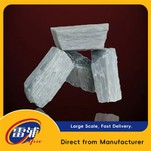

Alumina exists in several crystal forms, the most common and important being α-Al₂O₃ and γ-Al₂O₃. In addition, there are more than ten transition states, including β, δ, θ, η, and κ. These different forms are used in various fields due to their different crystal structures, thermal stability, and surface properties.
α-Al₂O₃ (Alpha Alumina) – The most stable crystal form
Structure: Hexagonal close-packed (HCP), oxygen ions arranged in an ABAB… pattern, Al³⁺ occupying 2/3 of the octahedral interstices, high lattice energy, and highly ordered structure.
Properties: Melting point as high as 2050℃, Mohs hardness 9, strong chemical inertness, insoluble in water, acids, or alkalis, corrosion resistant, and good electrical insulation.
Applications: Commonly known as corundum, used in the manufacture of refractory materials, abrasives, artificial gemstones (rubies/sapphires), ceramic substrates, and high-temperature structural components.
γ-Al₂O₃ (Gamma Alumina) – A Highly Active Transition Phase
Structure: Cubic close-packed (CCP), similar to spinel, with aluminum ions distributed in tetrahedral and octahedral voids, exhibiting numerous surface defects and pores.
Properties: Large specific surface area (200–600 m²/g), porous, strongly acidic surface, soluble in strong acids and bases, transforms into α-Al₂O₃ above 1200℃.
Applications: Also known as "activated alumina," widely used as a catalyst support, adsorbent, desiccant, and automotive exhaust purification material.
β-Al₂O₃ (Beta Alumina) – A Special Phase with Ionic Conductivity
Structure: Not pure Al₂O₃, but actually an aluminate containing alkali metals (such as Na⁺), possessing a layered structure that allows ions to migrate between layers.
Properties: Possesses the conductivity of cations such as Na⁺, has low density, and poor thermal stability.
Applications: Used as a solid electrolyte in sodium-sulfur batteries and a high-temperature ionic conductor material.
Other Transition Crystal Forms (δ, θ, η, κ, etc.)
Common Characteristics: All are intermediates in high-temperature phase transition processes, with structures between γ and α, gradually transforming towards the α phase with increasing temperature.
Characteristics:
θ-Al₂O₃: Monoclinic crystal system, moderate specific surface area, often used as a high-temperature catalyst support.
δ-Al₂O₃: Face-centered cubic structure, good thermal stability, used in wear-resistant coatings.
κ-Al₂O₃: Hexagonal crystal system, obtained by calcining gibbsite at 800–1150℃, used as a binder in refractory materials. ρ-Al₂O₃: Nearly amorphous with poor crystallinity, widely used in metallurgical refractory castables.