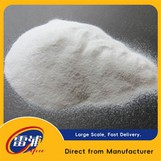

If you've ever held a smooth, precise metal part-say, a automotive engine component, a plumbing valve, or a complex aerospace casting-you've likely interacted with a product that relied on white corundum at every step of its creation. As someone who's spent over a decade sourcing, processing, and supplying white corundum for foundries across North America, I've seen firsthand how this high-performance fused alumina material is far more than just a generic abrasive. It's a behind-the-scenes workhorse that solves some of the foundry industry's most persistent challenges: surface quality, thermal stability, and production efficiency. Unlike lower-grade abrasives or refractories, white corundum's unique crystalline structure makes it tailored for specific foundry applications, and understanding those uses can help foundry operators cut costs, reduce defects, and improve part performance. Today, I want to break down its most critical foundry applications, explain why different grades of white corundum matter, and share how we work closely with foundries to match the right material to their unique needs.
Before diving into applications, let's quickly ground ourselves in what makes white corundum different from other common foundry materials, like brown fused alumina or silica sand. White corundum is produced by fusing high-purity alumina (Al₂O₃) in an electric arc furnace at temperatures over 2,000°C, which removes impurities like iron, silica, and sodium oxides to create a hard, dense, and chemically stable crystalline structure. This purity is why it outperforms many alternatives in high-stress foundry environments. Foundries often specify three core grades, each with targeted use cases: Ordinary White Corundum, Low-sodium White Corundum, and High-purity White Corundum. Ordinary grade, for example, strikes a balance between cost and performance for general-purpose uses, while low-sodium grade is optimized for applications where sodium contamination would ruin metal purity, and high-purity is reserved for the most demanding, precision-critical parts.
The first-and most high-profile-application of white corundum in foundries is in the manufacture of precision molds and cores, specifically as a refractory material for mold coatings and core washes. When casting metals like steel, iron, bronze, or even high-temperature superalloys for aerospace, the molten metal can reach temperatures of 1,500°C or higher. If the mold material isn't properly protected, the molten metal will react with the mold's binder or aggregate, causing surface defects like scabs, burns, or even incomplete fusion-defects that require expensive rework or render the part useless. White corundum solves this because its melting point is over 2,050°C, far higher than most casting temperatures, and it's chemically inert with nearly all molten metals (except for a small number of highly reactive alloys).
Foundries typically apply a thin layer of white corundum-based wash to the inner surface of the mold cavity or the exterior of sand cores. The grade here depends on the metal being cast: for mass-produced automotive engine parts, Ordinary White Corundum works well because it's cost-effective and provides consistent resistance to surface burning for standard steel and iron castings. But for applications like casting medical device implants or aerospace turbine blades, where even a single surface defect can lead to product failure, foundries switch to High-purity White Corundum (often 99.9% Al₂O₃) to eliminate any risk of chemical reaction between the mold coating and the molten alloy. I recently worked with a medical casting client who previously used silica-based coatings and was experiencing a 8% defect rate from silicon contamination in hip implant components. After we switched them to high-purity white corundum coatings, their defect rate dropped to less than 1%-a savings of over $120,000 annually in rework and scrap.
A related, but often overlooked, application is white corundum's use as a core aggregate in no-bake and shell molding processes. Cores are the internal shapes that create hollow features in cast parts, like engine cylinder bores or plumbing pipe interiors. These cores need to withstand two stresses: the heat of the molten metal and the mechanical force of the metal as it solidifies. Traditional core aggregates like silica sand have a tendency to expand when heated, leading to cracks in the core that result in rough internal surfaces or even blocked passages. White corundum, on the other hand, has extremely low thermal expansion-when heated to casting temperatures, it expands at less than one-tenth the rate of silica sand. This makes it ideal for cores for long, narrow passages (like engine camshaft bearings) where even a small crack can ruin the part. For this application, Low-sodium White Corundum is often the go-to grade because sodium can act as a flux, lowering the corundum's melting point slightly and increasing thermal expansion. A pump manufacturing client I partnered with told us that switching from silica cores to low-sodium white corundum cores reduced their internal surface rework for valve bodies by 15%, because the cores no longer cracked during casting.
Another critical use case for white corundum in foundries is surface preparation and post-casting finishing. Even with perfect molds and cores, cast parts will have minor surface irregularities-sprues, gates, and flash-left over from the casting process. Removing these efficiently without damaging the base part is essential for meeting quality standards. White corundum's high hardness (9 on the Mohs scale, second only to diamond and a few other materials) makes it ideal for abrasive blasting, grinding, and polishing of cast parts. Unlike cheaper abrasives like steel grit or aluminum oxide, white corundum produces sharp, uniform edges that cut through residual casting material quickly, and it generates less dust and fewer embedded particles, which is vital for parts that will be machined or coated later. For example, foundries that produce high-precision gears for heavy equipment use white corundum blasting to remove casting flash before heat treatment, ensuring that the gear's tooth surfaces are smooth and free of contaminants that could cause wear later. We supply a specialty grade of medium-grained white corundum for this exact application to a large construction equipment manufacturer, who has reported a 20% reduction in finishing time per part since switching from steel grit to white corundum.


White corundum also plays a key role in foundry furnace linings, a less visible but equally important application. Furnaces that melt and hold molten metal need refractory linings that can withstand repeated thermal cycling (heating to casting temperatures and cooling between melts) and chemical exposure from molten metal and furnace gases. Traditional furnace linings often use fire clay or basic magnesia, but these materials can degrade over time, leading to costly furnace downtime and contamination of the metal. White corundum-based refractories, typically made from high-purity fused corundum aggregates bonded with alumina cement, have excellent thermal shock resistance-meaning they can handle rapid temperature changes without cracking-and they're highly resistant to chemical corrosion from molten metal. For induction furnaces, which are widely used for melting small to medium batches of steel and alloy, corundum crucibles (a type of small, removable lining) are a staple. A small alloy foundry we work with was having to replace their magnesia crucibles every 6 months due to cracking and metal contamination; after switching to corundum crucibles, they've extended crucible life to over 18 months, saving thousands of dollars in replacement costs and reducing furnace downtime.
It's important to note that not all white corundum is the same, and choosing the wrong grade for a specific application can lead to wasted material, higher costs, or part failure. That's why we work closely with each of our foundry customers to audit their process: what metal they're casting, the complexity of the part, their defect rates, and their production volume. For a small job shop that casts gray iron for garden tools, Ordinary White Corundum is usually the best choice-enough performance to avoid defects at a price that fits their budget. For a tier 1 automotive supplier casting engine blocks, we'll often recommend a mix: ordinary grade for core washes and a finer grain of high-purity grade for critical surface finishes. For medical device foundries, we exclusively supply High-purity White Corundum to ensure no impurity contamination, with low-sodium grade as a secondary option for core work where thermal expansion is a top concern.
I've spent enough years in this industry to know that many foundries stick to what's worked for them for decades-often traditional materials like silica sand or generic abrasives. But over the past five years, I've seen more and more foundries adopt white corundum, and the driving force isn't just hype: it's real, measurable improvements in quality, cost, and efficiency. The key is understanding that white corundum isn't a one-size-fits-all material. Its strength lies in matching the right grade to the right process, whether that's a core for a small metal part or a lining for a high-temperature furnace.
If you're a foundry operator who's dealing with surface defects, core cracking, high finishing costs, or furnace downtime, I'd encourage you to reach out to us. We don't just sell white corundum-we partner with foundries to analyze their unique challenges, recommend the right grade and grain size, and provide ongoing support to ensure that our material delivers the results you need. Every foundry is different, and there's no "best" white corundum for every job, but there is a grade that will cut your defects, save you money, and help you produce better parts.
References
- ASM International. (2008). Properties of Cast Irons and Steels. ASM Handbook, Volume 1: Properties and Selection: Irons, Steels, and High-Performance Alloys.
- Foundry Management & Technology. (2021). "Refractory Materials for High-Temperature Casting Applications." Industrial Casting Solutions Quarterly.
- Abrasive Technology Association. (2022). "Fused Alumina Grades and Their Applications in Metal Finishing." Journal of Abrasive Materials Science.
- ASTM International. (2019). Standard Specification for Fused Alumina for Refractory Applications (ASTM C768-19).
- Medical Device and Diagnostic Industry. (2020). "Casting Materials for Implantable Medical Devices: Purity and Performance Requirements.