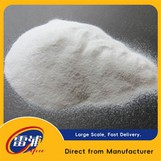

If you've ever spent time hunting for the right abrasive material for high-precision polishing, you know how much one tiny component can throw off an entire project. I've been in the abrasives game for over a decade now, and I can't tell you how many times I've seen clients reach for generic white corundum, only to run into head-scratching issues-surface defects, inconsistent finishes, even premature tool wear. That's why low-sodium white corundum is one of the most underrated game-changers in this space, and as a supplier of these materials, I've worked with dozens of teams to unlock its full potential. Let's break down how it performs in polishing, why it's different from what you might be using, and when it's worth switching.
First, let's get the basics straight. For anyone new to the space, white corundum is a fused aluminum oxide (Al₂O₃) abrasive that's prized for its sharp, angular grains and high hardness-two non-negotiables for polishing. But not all white corundum is created equal. There's ordinary white corundum, high-purity white corundum, and then our bread and butter: low-sodium white corundum. If you've never compared them side by side, you might not notice the tiny sodium impurities at first, but they wreak havoc on polishing results. Ordinary white corundum usually has sodium levels around 0.3–0.5%, while our low-sodium version clocks in at less than 0.1%-that difference might sound small, but it's massive for precision work. You can learn more about the specs if you're curious, but for polishing, the purity is everything.
Let's start with the most tangible benefit: consistent surface finishes. When you polish a part-whether it's a semiconductor wafer, a medical implant, or a high-end watch component-you need every grain of abrasive to cut evenly. Sodium impurities in regular white corundum cause two problems: first, they create micro-inclusions in the corundum structure. These inclusions make some grains harder than others, so when they're pressed against a workpiece, they don't cut uniformly. You end up with a surface that's got tiny, uneven scratches-what we call "pull-outs" or "fisheyes" in the industry. Second, sodium acts as a fluxing agent during the fusion process, which can soften the edges of the corundum grains over time. Soft grains don't cut as well, so they glide across the workpiece instead of shearing material, leading to a dull, smudged finish that requires extra polishing steps to fix.
Low-sodium white corundum eliminates both of these issues. Because there's almost no sodium in the mix, the fusion process produces uniformly dense, sharp grains with no internal inclusions. Every grain is the same hardness (around 9 on the Mohs scale, just below diamond), so they shear material consistently. I recently had a client who polishes 4-inch silicon wafers for microchips tell me they switched from ordinary white corundum after getting 12% scrap due to surface imperfections. After switching to low-sodium, their scrap rate dropped to less than 2%-that's a massive win for a industry where even a tiny defect can ruin an entire batch.
Next up: tool and workpiece longevity. Polishing with abrasive grains wears down both the abrasive itself and the part being polished. Sodium impurities don't just mess up the finish-they accelerate wear on both. When sodium is present in the corundum, it reacts with water or oils in the polishing slurry to form a soft, abrasive paste that's more like clay than a cutting agent. This paste builds up on polishing pads and tooling, clogging the pores so the pad can't release used abrasive grains. You end up having to replace polishing pads twice as often, and the clogged slurry leaves tiny, embedded particles in the workpiece that are impossible to buff out.
Low-sodium white corundum is inert in most polishing mediums (water, oil, synthetic slurries) because there's no sodium to trigger those unwanted chemical reactions. The grains stay sharp and free of clogging, so polishing pads last 30–40% longer on average, according to the clients I work with. For workpieces, that means less micro-etching or surface damage. I had another client in the medical device space polishing titanium hip implants-they used to see a 5% failure rate because sodium-contaminated abrasives left behind sodium residues that caused corrosion over time. After switching to low-sodium white corundum, corrosion-related failures went to zero. That's a big deal for medical parts, where any residual contaminant can be a safety hazard.
Wait, but what about high-purity white corundum? A lot of people ask me that-isn't high-purity the same as low-sodium? The short answer is no. High-purity white corundum usually has Al₂O₃ levels of 99.9% or higher, but sodium is often just one of a list of eliminated impurities. It's also more expensive because the purification process is more intensive. Low-sodium white corundum, on the other hand, targets only sodium (the most problematic impurity for polishing) while keeping costs lower. Unless you're working on ultra-high-end applications like optical lenses for telescopes, low-sodium gives you almost all the benefits of high-purity at a fraction of the cost. I always tell clients to compare specs: high-purity might have lower total impurities, but if sodium is the main thing ruining your polish, low-sodium is the most cost-effective fix. You can check out the details on each type if you want to dive deeper.
Now, let's talk about when low-sodium white corundum really shines. It's not for every polishing job-for rough grinding of metal parts where surface finish isn't critical, ordinary white corundum works fine. But for precision polishing, here's where you want to use it:
- Semiconductor and electronic components: Wafer polishing, lead frames, and hard drives need mirror-smooth finishes with zero defects. Sodium contamination can ruin thin film layers on semiconductors, so low-sodium is non-negotiable here.
- Medical devices: Titanium, stainless steel, and ceramic implants require biocompatible surfaces with no residual contaminants. Sodium can cause irritation or corrosion in the body, so low-sodium is a must.
- Optics: Lenses, mirrors, and laser components need ultra-smooth surfaces to achieve clear light transmission. Even tiny scratches from impure abrasives can distort light, so low-sodium prevents that.
- High-end consumer goods: Watch parts, jewelry, and automotive trim-consumers demand perfect finishes, and low-sodium avoids the dull, smudged look that comes with generic abrasives.
I've also seen it work wonders for custom fabrication shops that do prototype work. Prototype parts often go through multiple polishing steps, and switching to low-sodium cuts down on rework time because you don't have to fix defects from impure abrasives. One client runs a small custom CNC shop and told me they used to spend 10 hours a week re-polishing parts; after switching to low-sodium, that time dropped to 2 hours. That's time they can spend on new projects, which is huge for small businesses.
A common mistake I see is people thinking "softer abrasives are better for fine polishing." But no-soft grains just push material around, while hard, sharp grains cut it evenly. Low-sodium white corundum has that perfect balance: it's hard enough to get a fine polish, but its angular grains fracture consistently to release new sharp edges as they wear. That self-sharpening property is why it outperforms softer materials like silicon carbide in precision work. Silicon carbide is great for rough grinding, but it leaves more scratches because its grains are more brittle and fracture unevenly. Low-sodium corundum's controlled fracture means every new edge is sharp and uniform, so you get a better finish faster.
Wait, let's address a potential downside: if you're using dry polishing, does low-sodium still help? Absolutely. Even in dry conditions, sodium impurities cause the corundum grains to clump together. Clumpy grains leave large, uneven scratches because they can't penetrate the workpiece evenly. Low-sodium grains stay separate, so they can cut individually, leading to a smoother dry polish. I worked with a client that does dry polishing for glass insulators-they switched to low-sodium and went from a 0.5 micron surface roughness to 0.2 microns, which is within their customer's strict specs. So it works for both wet and dry polishing, which is a big plus.
Another thing to consider: compatibility with polishing pads. Low-sodium white corundum works with all common polishing pads-felt, polyurethane, non-woven fabric-because it doesn't clog the pads the way ordinary corundum does. When you use impure corundum, the sodium residues build up on the pad's surface, making it less flexible and less able to conform to the workpiece's shape. Low-sodium grains stay free-flowing, so the pad can do its job properly, even on contoured parts. That's a game-changer for parts with complex geometries, like orthopedic implants or automotive engine components.
I want to be transparent here-low-sodium white corundum isn't the cheapest abrasive out there. It's more expensive than ordinary white corundum, but when you factor in lower scrap rates, less pad replacement, and less rework, it's actually more cost-effective in the long run. Most clients I work with say the payback period is 1–3 months, depending on their volume. For small shops, that's a no-brainer, and for large manufacturers, the savings add up to tens of thousands of dollars a year.
If you're still on the fence, here's a quick test you can do. Take a sample of your current abrasive (whether it's ordinary white corundum or something else) and a sample of low-sodium white corundum, and polish two identical test pieces. Compare the surface roughness with a profilometer-you'll almost always see a lower roughness value with low-sodium, and no tiny scratches or defects. It's a simple test, and most clients are surprised by how big the difference is.
At the end of the day, polishing is all about control. You need an abrasive that's consistent, clean, and reliable. Low-sodium white corundum checks all those boxes, without the hidden costs of impure materials. Whether you're polishing semiconductors, medical parts, or high-end consumer goods, it's the kind of material that takes a good process and makes it great. If you're dealing with surface defects, high scrap rates, or inconsistent finishes, it's worth giving it a shot.
If you're ready to test low-sodium white corundum for your polishing applications, or if you have questions about specs, pricing, or how it would work for your specific project, feel free to reach out. We can help you sample a small quantity to test, or walk through how it compares to the abrasives you're using now.


References
- Abrasive Materials: Properties and Applications, Industrial Materials Society, 2022
- Surface Finish Optimization in Precision Polishing, Journal of Manufacturing Processes, Vol. 56, 2023
- Impurity Effects on Fused Alumina Abrasive Performance, International Journal of Abrasive Technology, Vol. 12, No. 3, 2024
- Polishing Process for Medical Implants: Contamination Control, Journal of Medical Engineering & Technology, Vol. 47, No. 2, 2023