

White corundum, a high - grade abrasive and refractory material, has been widely used in various industrial fields. As a white corundum supplier, I often encounter in - depth questions from clients regarding its properties, among which the surface energy of white corundum is a topic of keen interest. Understanding the surface energy of white corundum is essential as it directly impacts its performance in applications such as grinding, polishing, and refractory lining.
Concept of Surface Energy
Surface energy is a fundamental concept in the realm of materials science. It represents the excess energy present at the surface of a material compared to its bulk. At the surface of a solid like white corundum, atoms or molecules are in a different environment from those in the interior. In the bulk, atoms are surrounded by neighboring atoms on all sides, and the forces acting on them are balanced. However, at the surface, these atoms have unbalanced forces because there are no neighboring atoms on one side. This imbalance results in an excess energy, which is the surface energy.

The surface energy of a material is typically measured in units of energy per unit area, such as joules per square meter (J/m²). It plays a crucial role in many surface - related phenomena, including wetting, adhesion, and particle aggregation.
Factors Affecting the Surface Energy of White Corundum
Chemical Composition
White corundum is mainly composed of aluminum oxide (Al₂O₃). The purity of the aluminum oxide significantly affects the surface energy. High - purity white corundum, such as High - purity White Corundum, which contains a very high percentage of Al₂O₃ (usually above 99%), has a more uniform surface structure. The absence of impurities reduces the surface defects and irregularities, leading to a relatively higher and more consistent surface energy.
In contrast, ordinary white corundum, like the Ordinary White Corundum, may contain some impurities such as silicon dioxide (SiO₂), iron oxide (Fe₂O₃), etc. These impurities can disrupt the regular arrangement of Al₂O₃ molecules at the surface, creating local variations in the surface energy.
Surface Roughness
The surface roughness of white corundum particles is another important factor. A rougher surface has a larger surface area per unit mass compared to a smooth surface. When the surface area increases, the total surface energy also increases. For example, in the case of low - sodium white corundum, Low - sodium White Corundum, different production processes can result in different surface roughness. Some processes might create particles with a more porous or uneven surface, which in turn increases the overall surface energy.
Crystal Structure
White corundum has a specific crystal structure, usually in the form of hexagonal close - packed (HCP) or face - centered cubic (FCC) arrangements of aluminum and oxygen atoms. The crystal orientation at the surface can affect the surface energy. Different crystal planes have different atomic densities and bonding arrangements, leading to variations in the surface energy. For instance, certain crystal planes may have a higher density of exposed atoms, resulting in stronger unbalanced forces and higher surface energy.
Measurement of the Surface Energy of White Corundum
There are several methods to measure the surface energy of white corundum. One of the commonly used methods is the contact angle measurement. By measuring the contact angle between a liquid drop and the white corundum surface, the surface energy can be calculated using the Young's equation.
The Young's equation is given by: $\gamma_{SV}=\gamma_{SL}+\gamma_{LV}\cos\theta$
where $\gamma_{SV}$ is the solid - vapor surface energy, $\gamma_{SL}$ is the solid - liquid surface energy, $\gamma_{LV}$ is the liquid - vapor surface energy, and $\theta$ is the contact angle.
Another method is the inverse gas chromatography (IGC). In IGC, a small amount of white corundum is packed into a column, and a probe molecule is injected into the column. The interaction between the probe molecule and the white corundum surface can be analyzed to determine the surface energy.
Significance of Surface Energy in Applications
Grinding and Polishing
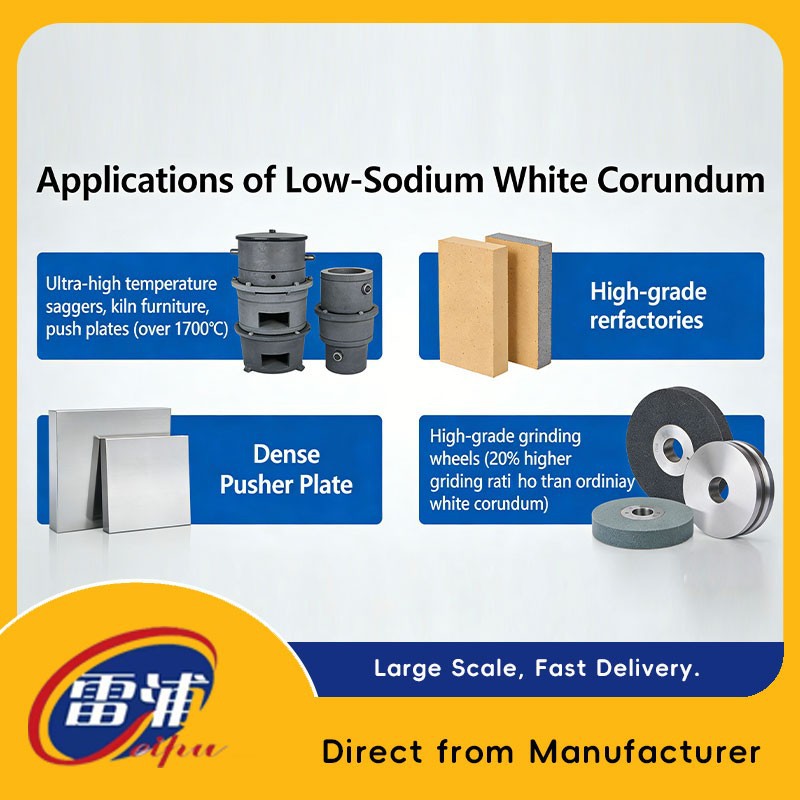
In grinding and polishing applications, the surface energy of white corundum affects its cutting ability and the quality of the finished surface. A higher surface energy means that the white corundum particles can better adhere to the grinding or polishing tool and have a stronger interaction with the workpiece surface. This results in more efficient material removal and a smoother finish. For example, when using high - purity white corundum with a relatively high and stable surface energy, the grinding process can be more precise, and the polished surface can achieve better gloss and flatness.
Refractory Applications
In refractory applications, the surface energy of white corundum influences its bonding with other refractory materials and its resistance to corrosion. A higher surface energy promotes better adhesion between white corundum and binders, enhancing the strength and durability of the refractory lining. Additionally, a well - bonded refractory lining with high - surface - energy white corundum can better resist the penetration of molten metals and slags, improving the overall performance of the refractory system.
Coating and Composite Materials
When white corundum is used in coating and composite materials, the surface energy affects the dispersion of the particles in the matrix. A proper surface energy ensures that the white corundum particles are uniformly dispersed in the coating or composite material, which is crucial for achieving consistent mechanical and physical properties. For example, in a polymer - white corundum composite, if the surface energy of white corundum is well - matched with the polymer matrix, the composite will have better mechanical strength and wear resistance.
Our Offerings as a White Corundum Supplier
As a professional white corundum supplier, we understand the importance of surface energy in different applications. We offer a wide range of white corundum products, including Low - sodium White Corundum, High - purity White Corundum, and Ordinary White Corundum. Each of these products has unique surface energy characteristics tailored to specific applications.
We use advanced production techniques to control the chemical composition, surface roughness, and crystal structure of our white corundum, thereby precisely adjusting the surface energy. Our technical team is always ready to provide in - depth guidance on the selection of the most suitable white corundum products according to your specific requirements.
Conclusion
The surface energy of white corundum is a complex yet crucial property that significantly impacts its performance in various industrial applications. By understanding the factors that affect surface energy and how to measure it, users can make more informed decisions when selecting white corundum products. As a reliable white corundum supplier, we are committed to providing high - quality products with optimized surface energy characteristics. If you are interested in our white corundum products or have any questions regarding surface energy and its applications, please feel free to contact us for a detailed discussion and procurement negotiation.
References
- Adamson, A. W., & Gast, A. P. (1997). Physical Chemistry of Surfaces. John Wiley & Sons.
- Zhang, L., & Ng, K. Y. S. (2014). Surface and Colloid Chemistry in Mineral Flotation. CRC Press.


